

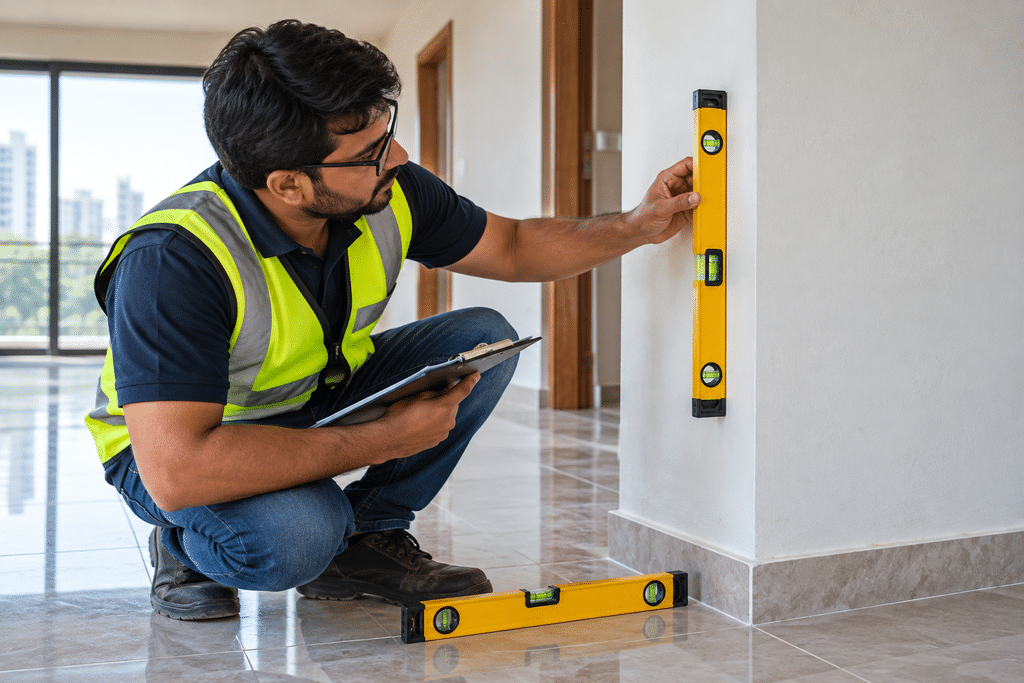
Walls, floors, doors and other building elements need to be properly aligned for a property to function as intended. During a home inspection, simple measuring tools can help identify visible deviations that may require closer examination.
A plumb bob and spirit level provides a vertical reference line using gravity, while a spirit level uses a bubble vial to indicate whether a surface is level or plumb. These traditional tools remain useful alongside modern inspection equipment.
In this guide, we explain how plumb bobs and spirit levels work, where they can be useful during a home inspection, and what inspectors can learn from alignment and level checks.
Make Smarter Property Decisions with Expert Home Inspection
From civil checks to electrical & plumbing audits — get a detailed inspection report within 24–48 hours. Protect your investment with India’s most trusted inspection service.
✅ Trusted by 20,000+ homeowners • Backed by 10+ years of expertise
What Is a Plumb Bob?
A plumb bob and spirit level is a weighted object suspended from a string. When allowed to hang freely, gravity brings the weight into a vertical position, creating a reference line known as a plumb line.
During an inspection, this vertical reference can be used to check whether a wall, door frame or other accessible vertical element appears aligned or deviates from the plumb line.
A plumb bob is particularly useful where a longer vertical reference is needed.
What Is a Spirit Level?
A spirit level, also called a bubble level, is a tool containing liquid-filled vials with an air bubble. The position of the bubble helps indicate whether a surface is level or plumb.
Depending on the vial and orientation, a spirit level can be used to check:
- Horizontal level
- Vertical plumb
- Alignment of accessible surfaces
The tool is commonly used for checking walls, floors, door frames, fixtures and other surfaces where a quick level or plumb check is required.
Plumb vs Level: What Is the Difference?
These two terms are often confused.
Plumb means vertical alignment. A plumb line follows the direction of gravity, so a wall that is plumb is vertically aligned.
Level refers to horizontal alignment. A spirit level can be used to check whether a surface is level by observing the position of its bubble.
Understanding this difference makes it easier to understand what inspectors are checking when they use these tools.
Key Uses of a Plumb Bob & Spirit Level in Home Inspection
🔹 Wall Alignment Checks – Helps identify visible deviations from vertical alignment.
🔹 Floor Level Checks – Helps identify noticeable slopes or unevenness in accessible areas.
🔹 Door & Window Alignment – Can help check whether accessible frames and installations are reasonably aligned.
🔹 Fixture Alignment – Useful for checking items such as cabinets, shelves and other installed elements.
🔹 Civil Inspection Support – Provides simple measurements/checks that can support the broader civil inspection process.
How Is a Plumb Bob Used to Check a Wall?
The plumb bob is suspended from a fixed point near the top of the wall and allowed to settle without interference. Once the bob stops swinging, the string provides a vertical reference line.
The inspector can then compare the wall’s position with the plumb line at suitable points. Differences can indicate that the wall is not aligned vertically and may warrant further assessment.
How Is a Spirit Level Used During Home Inspection?
A spirit level is placed against or on an accessible surface, depending on the type of check being performed.
The bubble position is then observed through the appropriate vial. A centered bubble indicates the tool is showing level or plumb according to the orientation being checked.
Inspectors can use this simple method to check accessible surfaces such as:
- Walls
- Floors
- Door frames
- Window frames
- Cabinets
- Shelves
- Other installed fixtures
Plumb Bob vs Spirit Level: What’s the Difference?
| Tool | Main purpose |
|---|---|
| Plumb Bob | Provides a vertical reference line |
| Spirit Level | Checks level and plumb using bubble vials |
| Plumb Bob | Useful for longer vertical reference checks |
| Spirit Level | Convenient for quick checks over the tool’s length |
Both tools can complement each other during a property inspection.
What Can Alignment Checks Reveal During a Property Inspection?
Alignment checks can help identify visible conditions such as:
- Noticeably leaning or out-of-plumb walls
- Uneven accessible surfaces
- Misaligned door or window frames
- Sloping floors
- Poorly aligned fixtures
- Installation-related deviations
These observations should be considered alongside other inspection findings rather than treated as proof of a particular underlying problem.
Limitations of Plumb Bob and Spirit Level Checks
These tools are useful for basic alignment checks, but they have limitations.
- They do not determine the cause of a wall deviation.
- They do not establish structural safety by themselves.
- A level check covers the specific area and orientation being tested.
- Surface irregularities can affect how the tool sits against a surface.
- Other inspection methods may be needed to understand the cause of an observed deviation.
Therefore, alignment measurements should be treated as one part of a broader property inspection.
How Housepedia Uses Alignment Tools During Property Inspection
At Housepedia, simple measurement and alignment tools can support the civil inspection of a property.
Aplumb bob and spirit level and spirit level or spirit level may be used to check accessible walls, floors, frames and fixtures for visible alignment or level deviations.
These observations are considered along with other inspection findings to provide a more complete picture of the property’s condition.
Buying a new or resale property? Get it inspected before making an important decision.
FAQs
FAQs About plumb bob and spirit level in Home Inspection
1. What is a plumb bob and spirit levelused for in home inspection?
Aplumb bob and spirit level provides a vertical reference line that can help check whether an accessible wall, frame or other vertical element is aligned with the direction of gravity.
2. What is a spirit level used for?
A plumb bob and spirit level uses bubble vials to indicate whether an accessible surface is level or plumb. It can be used for checking walls, floors, frames and fixtures.
3. What is the difference between plumb and level?
Plumb refers to vertical alignment, while level refers to horizontal alignment. A spirit level can be used to check both depending on its orientation and vial.
4. Can a plumb bob detect a leaning wall?
A plumb bob and spirit level can provide a vertical reference that helps identify whether a wall appears to deviate from vertical alignment. It does not, by itself, determine why the wall is leaning or how serious the condition is.
5. Can a spirit level be used to check floors?
Yes. Aplumb bob and spirit level can be used to check the level of suitable accessible surfaces, including floors. The result represents the area being checked rather than automatically describing the entire floor.