

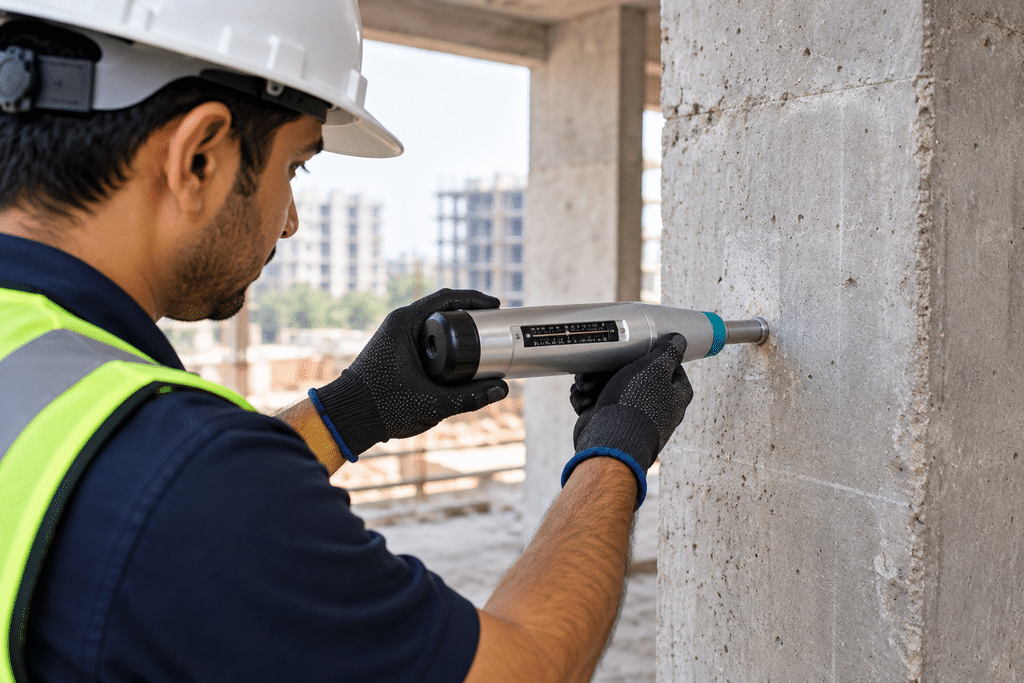
A concrete rebound hammer is a non-destructive testing tool used to assess the surface hardness of concrete. It is commonly used during civil inspection to obtain quick readings from accessible concrete surfaces such as beams, columns and slabs.
For property buyers, homeowners and building inspectors, this type of testing can provide additional information about the condition of selected concrete areas without breaking or drilling the surface.
However, a rebound hammer test should not be considered a standalone confirmation of concrete strength or structural safety. The readings can be influenced by several factors and should be interpreted along with visual observations and other relevant inspection methods.
Make Smarter Property Decisions with Expert Home Inspection
From civil checks to electrical & plumbing audits — get a detailed inspection report within 24–48 hours. Protect your investment with India’s most trusted inspection service.
✅ Trusted by 20,000+ homeowners • Backed by 10+ years of expertise
What Is a Concrete Rebound Hammer?
A concrete rebound hammer is a handheld instrument designed to measure the rebound of a spring-loaded hammer after it impacts a concrete surface.
The instrument provides a rebound value based on the response of the concrete surface to the impact.
In simple terms, the process involves:
- Positioning the rebound hammer against a suitable concrete surface.
- Applying the instrument correctly to the surface.
- Releasing the internal hammer mechanism.
- Recording the rebound reading.
- Comparing and interpreting readings from appropriate test locations.
The result provides information related to the surface hardness characteristics of the tested concrete.

How Does a Concrete Rebound Hammer Work?
The working principle of a concrete rebound hammer is based on the rebound of an internal mass after it impacts the concrete surface.
When the instrument is pressed against the concrete, its spring-loaded mechanism releases a controlled impact. The internal hammer then rebounds from the surface, and the instrument records the rebound value.
Generally, variations in rebound readings can indicate differences in surface hardness between tested locations.
However, the reading is not determined by concrete strength alone. Surface condition, moisture, testing direction, roughness, carbonation and other factors can influence the result.
This is why proper testing technique and interpretation are important.
Why Is a Concrete Rebound Hammer Used in Civil Inspection?
A concrete rebound hammer can be useful as part of a broader civil inspection because it allows selected concrete surfaces to be assessed without destructive testing.
During a property inspection, it may help an inspector:
- Obtain quick surface rebound readings
- Compare selected concrete areas
- Identify variations between test locations
- Document observations during an inspection
- Identify areas that may require further examination
- Support other visual and non-destructive inspection observations
The test is particularly useful when an inspector needs additional information without immediately damaging the concrete surface.
What Can a Rebound Hammer Test Tell You?
A rebound hammer test mainly provides information related to the surface hardness and rebound response of concrete.
When readings are taken from suitable locations under reasonably consistent conditions, they may help identify variations between different areas.
For example, if several similar concrete surfaces produce noticeably different readings, the variation may indicate that those locations deserve closer examination.
However, the reading should always be considered in context.
A single rebound value should not be used on its own to make conclusions about the complete condition of a concrete element.
Does a Concrete Rebound Hammer Measure Concrete Strength?
This is one of the most important points to understand.
A concrete rebound hammer does not directly measure compressive strength.
The instrument measures rebound characteristics associated primarily with the surface condition and hardness of the concrete. Rebound values can sometimes be correlated with estimated compressive strength under appropriate conditions, but such estimates depend on factors such as calibration, concrete composition, testing conditions and established correlations.
Therefore, a rebound hammer reading should not automatically be presented as proof that concrete is structurally safe or that it has a particular compressive strength.
Where precise concrete strength information is required, additional testing may be necessary.
Factors That Can Affect Rebound Hammer Readings
Several factors can influence the readings obtained during a concrete rebound hammer test.
Surface Condition
Rough, damaged or uneven surfaces can affect the rebound response.
Moisture
Moisture conditions can influence readings, so the condition of the tested surface should be considered.
Testing Direction
The orientation of the instrument during testing can affect the result.
Concrete Age
The age and condition of concrete can influence surface characteristics.
Carbonation
Carbonation of the concrete surface may affect rebound readings.
Surface Preparation
Loose material, coatings or unsuitable surfaces can influence the reliability of readings.
Instrument Condition and Calibration
The testing instrument should be appropriately maintained and checked according to the manufacturer’s requirements.
Because of these factors, readings should be interpreted carefully rather than treated as isolated numbers.
Where Can a Concrete Rebound Hammer Be Used?
Depending on the inspection scope and accessibility, a concrete rebound hammer may be used on suitable concrete elements such as:
- Beams
- Columns
- Slabs
- Concrete walls
- Other accessible concrete surfaces
The exact testing locations depend on the property, construction type, accessibility and purpose of the inspection.
Not every concrete surface is automatically suitable for rebound hammer testing.
Concrete Rebound Hammer Test in a Property Inspection
For property buyers, a concrete rebound hammer can be one of several tools used during a detailed civil inspection.
A professional inspection may begin with visual observation of accessible areas and then use appropriate instruments where additional information is useful.
Depending on the inspection scope, an inspector may examine:
- Visible cracks
- Surface deterioration
- Dampness and moisture
- Concrete surface condition
- Finishing quality
- Accessible structural elements
- Other visible civil defects
The rebound hammer test can provide additional surface-related readings where appropriate.
This makes the concrete rebound hammer a supporting inspection tool rather than a replacement for a complete property inspection.
Concrete Rebound Hammer vs Visual Inspection
Visual inspection and rebound hammer testing serve different purposes.
Visual Inspection
A visual civil inspection can help identify observable conditions such as:
- Cracks
- Surface damage
- Dampness
- Poor finishing
- Visible deterioration
- Other accessible defects
Rebound Hammer Testing
A concrete rebound hammer provides rebound readings from selected concrete surfaces.
The two methods can complement each other.
Visual inspection helps document what can be observed, while instrument-based testing can provide additional measurements or readings where appropriate.
Can a Rebound Hammer Test Detect Cracks?
A concrete rebound hammer is not primarily a crack-detection tool.
Visible cracks should first be examined through visual inspection. Their location, pattern, width and surrounding condition can then be documented as appropriate.
If a crack affects the testing area, it may also influence the rebound reading.
Therefore, rebound hammer testing should not be used as a replacement for proper crack inspection.
Limitations of Concrete Rebound Hammer Testing
Although a concrete rebound hammer is useful, it has limitations.
The test:
- Does not directly measure compressive strength
- Does not determine the cause of a defect
- Does not replace a complete civil inspection
- Does not by itself confirm structural safety
- Can be affected by surface conditions
- Requires appropriate testing technique
- Requires careful interpretation of results
These limitations are important because a numerical reading can appear very precise while still being affected by the condition of the tested surface and testing environment.
How Housepedia Uses a Concrete Rebound Hammer During Inspection
At Housepedia, the concrete rebound hammer can be used as one of the inspection tools where appropriate to the inspection scope.
The readings are considered along with visual observations and other relevant inspection findings rather than being treated as a standalone conclusion.
This approach helps create a more complete inspection record of accessible property conditions.
The objective of a civil inspection is to document observable defects, variations and conditions that may be relevant to the property owner or buyer.
Frequently Asked Questions
Q1. What is a concrete rebound hammer?
A concrete rebound hammer is a non-destructive testing instrument used to obtain rebound readings from concrete surfaces and assess their surface hardness characteristics.
Q2. Is a rebound hammer test destructive?
No. A rebound hammer test is generally considered non-destructive because it does not require the concrete to be drilled or broken for the test.
Q3. Does a concrete rebound hammer directly measure strength?
No. It primarily measures rebound characteristics related to surface hardness. Any correlation with compressive strength requires appropriate conditions, calibration and interpretation.
Q4. Where can a rebound hammer be used?
It can be used on suitable accessible concrete surfaces such as selected beams, columns, slabs and walls, depending on the inspection requirements.
Q5. Can a rebound hammer replace a civil inspection?
No. It is one inspection tool and should be considered alongside visual inspection and other relevant assessment methods.
Q6. Can a rebound hammer detect hidden defects?
It may help identify variations in the surface response of tested concrete, but it cannot by itself identify every hidden defect or determine the exact cause of a problem.
Q7. Is rebound hammer testing useful for new flats?
It can be considered as part of a broader civil inspection where the testing is appropriate for the accessible concrete surfaces and the inspection scope.