

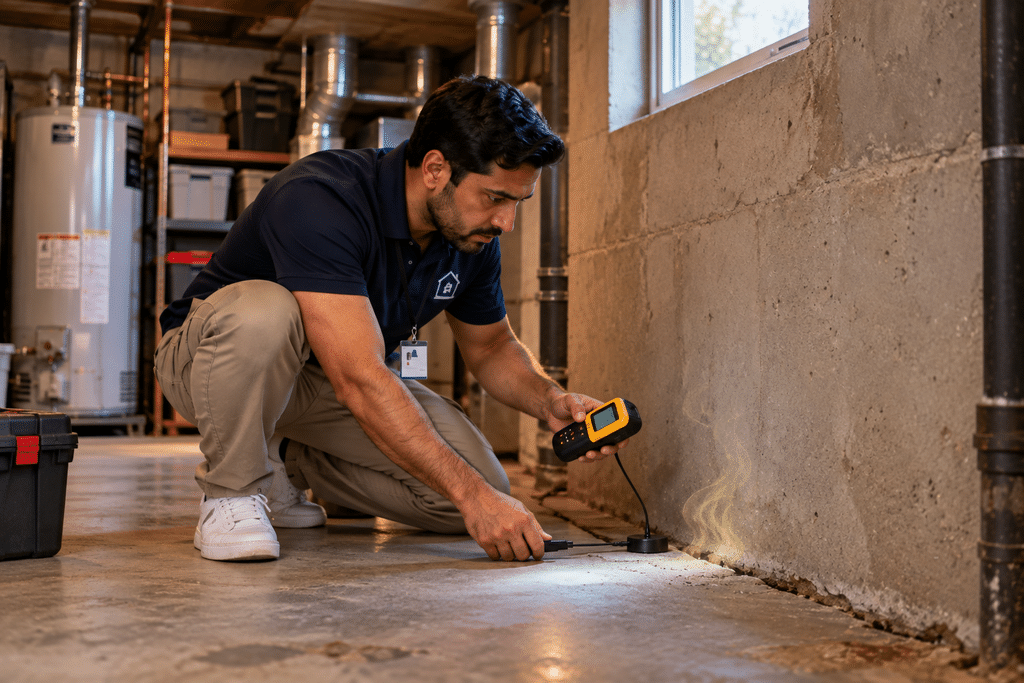
Your basement can look clean, freshly painted and completely normal. You may use it as a bedroom, home office, gym, study room, storage area or family space. But there is one thing you cannot identify simply by looking around radon.
Radon is a naturally occurring radioactive gas. It has no colour, smell or taste, so your senses cannot tell you whether it is present. It can move through soil and rock beneath or around a property and enter a building through cracks, construction joints, gaps around pipes, drains and other openings connected to the ground.
This is why a basement deserves attention when homeowners are thinking about indoor radon. A clean-looking room does not prove that radon is absent. The actual level can only be understood through appropriate measurement.
What Is Radon Gas?
Radon is a naturally occurring radioactive gas produced by the decay of uranium in rocks and soil. Because it is a gas, it can move through the ground and find pathways into buildings.
Once inside, radon can accumulate in indoor air. Indoor concentrations can vary from one property to another depending on factors such as local geology, construction, entry pathways and ventilation.
In simple terms, radon is not something you can identify by a visible stain, a particular smell or the appearance of a room. If you want to know whether elevated radon is present, the property needs to be measured.
How Does Radon Enter a Home?
Radon gas in a house can enter from soil and rock around or beneath a building through openings that connect indoor spaces with the ground.
- Cracks in floors or foundation areas
- Floor-wall and construction joints
- Gaps around pipes, cables and utility lines
- Sumps and drains
- Openings around services or other ground-connected areas
- Porous or hollow construction areas that can allow soil gas movement
A crack or gap does not automatically mean that a home has elevated radon. It simply provides a possible entry pathway. The actual radon concentration still needs to be measured.
How Can Radon Affect Your Health?
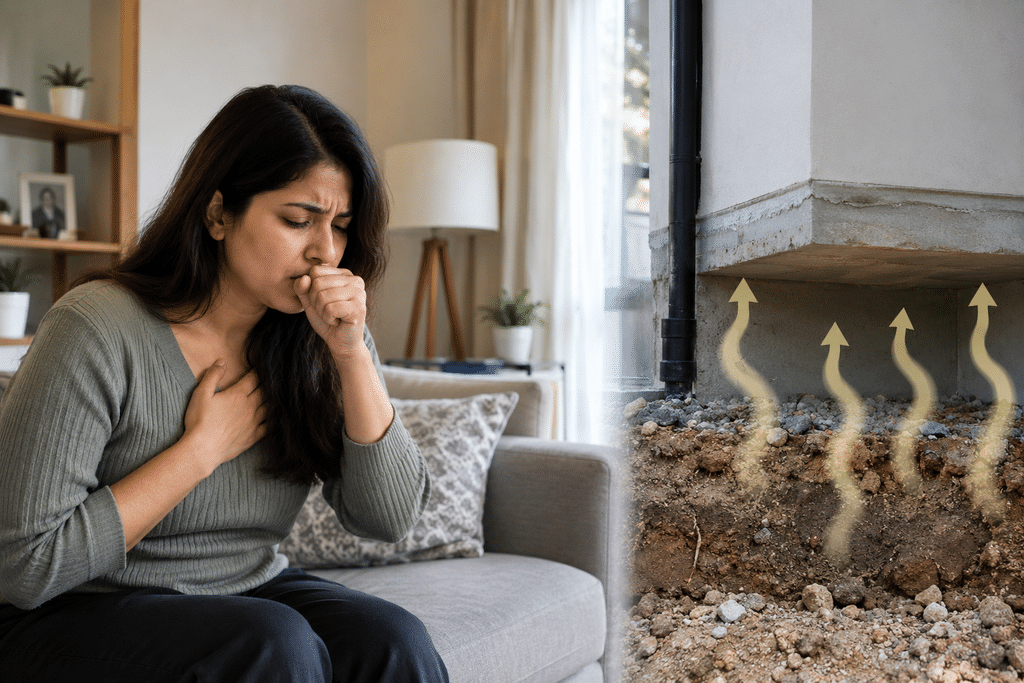
Radon exposure is mainly a long-term health concern. When radon and its radioactive decay products are inhaled, they can deposit in the airways and damage lung tissue and DNA over time.
The main established health effect of prolonged exposure to elevated indoor radon is an increased risk of lung cancer. The World Health Organization identifies radon as one of the leading causes of lung cancer and estimates that it contributes to about 3% to 14% of lung cancers in a country, depending on average radon levels and smoking prevalence.
The risk is higher for people who smoke or have a history of smoking. Effect of smoking and radon substantially increases lung-cancer risk compared with either exposure alone.
Radon does not usually cause immediate warning signs. A person cannot diagnose radon exposure from a cough, tiredness or breathing difficulty because these symptoms can have many other causes. In most cases, people do not know they are exposed unless the indoor air is tested.
Concerned About Your Property?
Get your property professionally inspected and understand its physical condition before small issues become bigger problems.
Why Are Basements More Important for Radon?
Basements and lower-ground rooms are especially relevant because they are closer to the soil beneath a property. These spaces can have greater contact with soil gas and may contain several potential entry points.
Radon does not originate from the basement itself. It comes naturally from soil and rock beneath or around the property. A basement can provide pathways through which the gas enters and an enclosed indoor space where it may accumulate.
This becomes particularly relevant when a basement is used as a bedroom, office, children’s room, gym, study room or another regularly occupied space.
A Basement Does Not Automatically Mean High Radon
Having a basement does not prove that a property has elevated radon. At the same time, a clean or newly constructed basement does not prove that radon is absent.
Because radon cannot be seen or smelled, appearance is not a reliable way to assess it. Testing is the practical way to find out the actual level inside the property.
What Basement Areas Should Homeowners Check?
When looking at a basement or lower-ground area, homeowners can pay attention to physical conditions that may provide potential entry pathways:
- Cracks in the floor or walls
- Floor-wall joints and construction joints
- Gaps around pipes, cables and drains
- Utility openings and service penetrations
- Sumps or other openings connected to the ground
- Poorly ventilated or enclosed lower-level spaces
These observations do not tell you the radon concentration. They help identify physical conditions that may deserve further attention.
What Does Radon Gas Smell Like? Can You See It?
Nothing. Radon is odourless, colourless and tasteless.
A musty smell in a basement should not be assumed to be radon. It may instead indicate dampness, moisture, mould or poor ventilation and should be investigated separately.
Likewise, the absence of a smell does not mean that radon is absent.
How Can You Know If Your Basement Has Radon?
The only practical way to know the radon concentration inside a particular home is to use an appropriate radon test or measurement device.
A radon gas test kit or monitor is placed in a suitable indoor location for the required radon testing period. Depending on the device, the result may be analysed by a laboratory or displayed electronically.
Correct placement and following the manufacturer’s instructions are important for a meaningful result. A visual inspection of a basement cannot measure radon concentration.
Radon Gas in India: What Should Homeowners Know?
Indoor radon has been studied in different parts of India, and research has found variation between locations and buildings. Indian studies have also examined the influence of ventilation, construction and other building characteristics on indoor radon.
Research from northern Haryana has measured indoor radon and thoron in residential homes and highlighted the relevance of ventilation and building characteristics. This is useful Indian evidence, but it should not be presented as a direct measurement of Delhi-NCR.
For Indian homeowners, the important point is simple: radon levels should not be assumed to be the same in every city, neighbourhood or property. The actual condition of a particular home is better understood through appropriate measurement.
Is Radon a Concern for Gurgaon Homes?
Gurgaon has a wide mix of residential properties, including high-rise apartments, independent houses, basements, semi-basement areas and lower-ground spaces.
Radon can enter buildings through cracks, construction joints, gaps around pipes, drains and other openings connected to the ground. This makes regularly occupied basements and lower-ground rooms relevant places to consider radon testing.
This does not mean that every Gurgaon home has elevated radon. It means that homeowners cannot determine the radon level of a specific property from its location or appearance alone.
If you live in Gurgaon and regularly use a basement or lower-level room, dedicated radon testing can provide property-specific information about the indoor radon level.
What About Delhi-NCR Basements?
Delhi-NCR includes apartments, independent houses, basements, semi-basement spaces, ground-floor homes and newly constructed residential developments. Construction, ventilation and the relationship between a building and the ground can differ from one property to another.
Radon can enter through floor cracks, wall cracks, construction joints, pipe gaps, drains and other openings connected to the ground. Once inside, it can accumulate in indoor air.
This makes basements and other lower-level areas important places to pay attention to, especially when they are used as bedrooms, offices, study rooms or other regularly occupied spaces.
If you live in Delhi, Gurgaon, Noida, Faridabad or Ghaziabad and the radon level of your lower-level space is unknown, a dedicated radon test can help determine the actual level inside that property.
How Can HousePedia Check the Property?
HousePedia home inspection checks the property for physical conditions such as cracks, gaps, construction joints and other civil defects that may create potential entry pathways from the ground.
For Delhi-NCR homes, this can be particularly relevant when inspecting basements, lower-ground areas and other spaces close to the ground.
However, a standard HousePedia home inspection does not measure radon concentration. If radon is a concern, a dedicated radon testing is required to determine the actual level inside the property.
In simple terms: HousePedia checks the physical condition of the property; dedicated radon testing measures the radon level.
What Should You Do If You Use a Basement Regularly?
- Find out whether the property has ever been tested for radon.
- If the radon level is unknown, consider appropriate radon testing.
- Check physical entry pathways such as cracks and gaps around services.
- Do not rely on smell, appearance or general symptoms to identify radon.
- Investigate dampness, seepage or visible civil defects separately.
- If testing shows elevated levels, seek appropriate mitigation advice.
Final Takeaway: You Cannot See Radon — So Test for It
Radon is invisible, odourless and tasteless. That makes it easy to overlook, especially when a basement or lower-level room looks clean and normal.
A clean-looking property does not prove that radon is absent, and a visible crack does not prove that radon is elevated.
For homeowners in Delhi-NCR, the practical approach is simple: understand the physical condition of the property, pay attention to regularly occupied lower levels and use dedicated radon testing when you need to know the actual indoor radon concentration.
You cannot see or smell radon. Testing is how you find out whether it is present at an elevated level.
Frequently Asked Questions About Radon Testing
Is Radon Testing Really Necessary?
If the radon level in a home is unknown, radon testing is the way to determine whether elevated radon is present. It can be particularly relevant when a basement or lower-level area is regularly occupied.
How Does Radon Testing Work?
A dedicated radon testing device is placed in an appropriate indoor location for a defined period. The device or laboratory analysis then provides a measurement of radon concentration.
How Do Radon Test Kits Work?
A radon gas test kit or detector measures radon concentration over a specified period. Correct placement and following the device instructions are important for a meaningful result.
What Does Radon Gas Smell Like?
Nothing. Radon has no smell, colour or taste.
Are Basements More Likely to Have Radon?
Radon levels are often higher in basements and other ground-contact spaces, but not every basement has elevated radon. Measurement is needed to know the actual level.
Can a Home Inspection Detect Radon?
A standard home inspection does not automatically measure radon testing. A dedicated radon test is required to determine indoor radon concentration.
Can a New Home Have Radon?
Yes. New construction does not automatically mean that radon is absent. Indoor levels depend on factors such as geology, construction pathways and ventilation.
What If Your Home Has a Problem You Haven’t Noticed Yet?
Cracks, hidden gaps and other civil defects may not always be obvious during a normal walkthrough. A professional property inspection can help you understand what is really happening inside your property.